For anyone who may be interested, I'll post my final project for one of my Instructional Design courses for my PhD program. We were assigned to create a lesson on something of interest to us, paper-based, self-paced, that would take learners approximately 20 minutes to complete. The project was to include three objectives, each with its own practice exercise and related test question at the end. I chose the topic of mnemonics. Just FYI...the blog doesn't support the formatting that I had (various fonts and colors, plus special formatting), but you'll get the idea.
Examples of the different types of mnemonics are:
Songs –
*The ABC song
*“School House Rock” songs
Acronyms -
*ROY G. BV - The colors of the spectrum –
Red, Orange, Yellow, Green, Blue, Violet *HOMES – The Great Lakes –
Huron, Ontario, Michigan, Erie, Superior Acrostics –
*To remember the planets: My Very Educated Mother Just Served Us Nine Pizzas
Introduction:
From the time we are young we learn and remember information with mnemonic techniques (the ABC song, for example).  Even as we get older, mnemonic strategies can continue to be an effective strategy in remembering information. This can be beneficial in various learning settings, including the workplace.
These lessons will help you learn what mnemonics are, some examples of the different types of mnemonics, and how to create your own mnemonics to remember information. There are three lessons, each with its own objective and practice exercise. You will have several opportunities to review the new information that is being presented
Upon completion of instruction, you should be able to meet the following objectives:
1. After reviewing the mnemonic presentation materials, you will identify three different types of mnemonics.
2. On completion of instruction, you will correctly provide one example of each of your three identified types of mnemonics.
3. On completion of instruction, you will create one unique mnemonic to
remember a piece of information of your own choice. Lesson Objective #1:
After reviewing the mnemonic presentation materials, you will identify three different types of mnemonics.
Points to Ponder:
*How do you remember information?
*Do you remember information easily, or do you struggle to remember information?
This lesson will introduce you to tools that will help you remember information more effectively. By the end of this instruction, you will understand what mnemonics are, and will identify three different types of mnemonics.
Points to Ponder:
*Have you ever used a song or rhyme, or any other “memory hook” to learn or remember information?
*What was the “memory hook”?
*Do you remember the information it was supposed to help you remember? Mnemonics or mnemonic devices are learning aids which help us remember information. Mnemonics are a memory strategy, not necessarily a comprehension strategy.
There are several different types of mnemonics:
*Songs – Information to be remembered is set to music and made into songs.
*Acronyms – The information to be remembered is abbreviated, utilizing only the first letter of each word, making a new word.
*Acrostics – The first letter of each word in a list to be remembered is made into a new word. The new words then combine into a (usually) silly sentence.
*Rhymes – Similar to songs, but without the music; just utilizes the patterns and cadence of rhythm.
Other, less common strategies:
*Pegword - Items to be remembered are “hung on a peg,” and visualized.
*Loci – Items to be remembered are arranged visually, corresponding with locations in a familiar setting, such as a home or town.
*Visual images – Any kind of visual cue to aid in remembering information.
*Physical – Utilizing some type of physical activity or strategy to remember information.
Practice Exercise:
*Without looking at the list of mnemonics, see how many of them you can remember.
Even as we get older, mnemonic strategies can continue to be an effective strategy in remembering information. This can be beneficial in various learning settings, including the workplace.These lessons will help you learn what mnemonics are, some examples of the different types of mnemonics, and how to create your own mnemonics to remember information. There are three lessons, each with its own objective and practice exercise. You will have several opportunities to review the new information that is being presented
Upon completion of instruction, you should be able to meet the following objectives:
1. After reviewing the mnemonic presentation materials, you will identify three different types of mnemonics.
2. On completion of instruction, you will correctly provide one example of each of your three identified types of mnemonics.
3. On completion of instruction, you will create one unique mnemonic to
remember a piece of information of your own choice.
Lesson Objective #1:After reviewing the mnemonic presentation materials, you will identify three different types of mnemonics.
Points to Ponder:
*How do you remember information?
*Do you remember information easily, or do you struggle to remember information?
This lesson will introduce you to tools that will help you remember information more effectively. By the end of this instruction, you will understand what mnemonics are, and will identify three different types of mnemonics.
Points to Ponder:
*Have you ever used a song or rhyme, or any other “memory hook” to learn or remember information?
*What was the “memory hook”?
*Do you remember the information it was supposed to help you remember?
Mnemonics or mnemonic devices are learning aids which help us remember information. Mnemonics are a memory strategy, not necessarily a comprehension strategy.There are several different types of mnemonics:
*Songs – Information to be remembered is set to music and made into songs.
*Acronyms – The information to be remembered is abbreviated, utilizing only the first letter of each word, making a new word.
*Acrostics – The first letter of each word in a list to be remembered is made into a new word. The new words then combine into a (usually) silly sentence.
*Rhymes – Similar to songs, but without the music; just utilizes the patterns and cadence of rhythm.
Other, less common strategies:
*Pegword - Items to be remembered are “hung on a peg,” and visualized.
*Loci – Items to be remembered are arranged visually, corresponding with locations in a familiar setting, such as a home or town.
*Visual images – Any kind of visual cue to aid in remembering information.
*Physical – Utilizing some type of physical activity or strategy to remember information.
Practice Exercise:
*Without looking at the list of mnemonics, see how many of them you can remember.
Points to Ponder:
*Can you identify any examples of mnemonics you have used in the past?
*Which type of mnemonic were they?
Feedback:
Review the types of mnemonics and the definitions. Review your answers to the “Practice Exercise” and “Points to Ponder” to see if you have identified them correctly. Review the types of mnemonics and their definitions, and then rephrase the definitions in your own words. Then continue to think of examples of mnemonics you have used, and in which category they would fall.
Lesson Objective #2:
On completion of instruction, you will correctly provide one example of each of your three identified types of mnemonics.
Points to Ponder:
*Think about mnemonic tools that you have used. For example, can you remember the order of operations in mathematical equations? Can you name the planets of the solar system in order?
This lesson will help you understand the different types of mnemonics. By the end of this instruction, you will be able to provide one example of each of the three types of mnemonics that you identified in Lesson #1.
Points to Ponder:
*How do you remember the order of operations in mathematical equations, the names of the planets in order, or the number of days in each month?
Examples of the different types of mnemonics are:
Songs –
*The ABC song
*“School House Rock” songs
Acronyms -
*ROY G. BV - The colors of the spectrum –
Red, Orange, Yellow, Green, Blue, Violet
*HOMES – The Great Lakes –Huron, Ontario, Michigan, Erie, Superior
Acrostics –*To remember the planets: My Very Educated Mother Just Served Us Nine Pizzas
(Mercury, Venus, Earth, Mars, Jupiter, Saturn, Uranus, Neptune, Pluto)
*To remember the mathematical order of operations: Please Excuse My Dear Aunt Sally
(Parenthesis, Exponents, Multiplication, Division, Addition, Subtraction)
*To remember the first nine presidents of the United States:
*To remember the mathematical order of operations: Please Excuse My Dear Aunt Sally
(Parenthesis, Exponents, Multiplication, Division, Addition, Subtraction)
*To remember the first nine presidents of the United States:
Would A Jolly Man Make A Jolly Visitor
(Washington, Adams, Jefferson, Madison, Monroe, Adams, Jackson, VanBuren)
*To remember the lines in the treble cleff: Every Good Boy Deserves Fudge (EGBDF) Rhymes –
*I before E, except after C. Or as sounding as A in neighbor and weigh.
*Thirty days hath September, April, June and November. All the rest have thirty-one, except February, which has 28.
*Columbus sailed the ocean blue in 1492.
Other less common strategies –
*Pegword – For example, remember “one is a bun, two is a shoe, three is a tree, four is a door, five is a hive, six is sticks, seven is heaven, eight is a gate, nine is a line, and ten is a hen.” Then, associate each item in the list of things you need to remember with the corresponding word. Create a visual image with your item and the image corresponding with the number.
*Loci – This method was originated by the great orators of old. They would remember items in their speeches by visually attaching each idea to be covered to a location in their home or town. Then, as they spoke, they could visually “walk” through and remember the information.
*Visual images – Anything drawn to give a visual representation of the information to be remembered. One Utah teacher had her students draw “totem poles” on a map of the state, with visual representation of the names of each county (Washington, Iron, Beaver, Summit, etc.)
*Physical – For example: Using knuckles and spaces between to remember the number of days in each month; or the “Magic Nine” times tables with fingers. (Hold hands in front of you with fingers spread out. For 4 x 9, put down the fourth finger from the left – the left index finger. How many fingers are on the left? 3 How many fingers are on the right? 6 The answer is 36.)
Practice Exercise:
*Without looking at the information, see how many examples of each type of mnemonic you can remember.
Points to Ponder:
*Try to identify your own examples of each type of mnemonic that you have used in the past.
Feedback:
Review the types of mnemonics and examples. Review your answers to the “Practice Exercise” and “Points to Ponder” to see if you have identified them correctly. Begin thinking about a mnemonic you could create in order to remember a piece of information. Lesson Objective #3:
On completion of instruction, you will create one unique mnemonic to remember a piece of information of your own choice.
Points to Ponder:
*Have you ever needed to remember a long list of vocabulary terms, or the order in which something occurs, or a long quote? How have you organized the material so that you can remember it most effectively?
This lesson will help you understand how to effectively create your own mnemonics. By the end of the instruction, you will create one mnemonic to remember a piece of information.
Points to Ponder:
*Have you ever created your own mnemonic in the past to remember information? Please take this opportunity to review what mnemonics are, the different types of mnemonics, and their definitions and examples. Are there any that you don’t understand? Review the definitions and examples for a better understanding.
Practice Exercise:
Now that you have learned about the different types of mnemonics, create your own mnemonic to remember a piece of information (or list, etc.) of your choice.
(Washington, Adams, Jefferson, Madison, Monroe, Adams, Jackson, VanBuren)
*To remember the lines in the treble cleff: Every Good Boy Deserves Fudge (EGBDF)
Rhymes –*I before E, except after C. Or as sounding as A in neighbor and weigh.
*Thirty days hath September, April, June and November. All the rest have thirty-one, except February, which has 28.
*Columbus sailed the ocean blue in 1492.
Other less common strategies –
*Pegword – For example, remember “one is a bun, two is a shoe, three is a tree, four is a door, five is a hive, six is sticks, seven is heaven, eight is a gate, nine is a line, and ten is a hen.” Then, associate each item in the list of things you need to remember with the corresponding word. Create a visual image with your item and the image corresponding with the number.
*Loci – This method was originated by the great orators of old. They would remember items in their speeches by visually attaching each idea to be covered to a location in their home or town. Then, as they spoke, they could visually “walk” through and remember the information.
*Visual images – Anything drawn to give a visual representation of the information to be remembered. One Utah teacher had her students draw “totem poles” on a map of the state, with visual representation of the names of each county (Washington, Iron, Beaver, Summit, etc.)
*Physical – For example: Using knuckles and spaces between to remember the number of days in each month; or the “Magic Nine” times tables with fingers. (Hold hands in front of you with fingers spread out. For 4 x 9, put down the fourth finger from the left – the left index finger. How many fingers are on the left? 3 How many fingers are on the right? 6 The answer is 36.)
Practice Exercise:
*Without looking at the information, see how many examples of each type of mnemonic you can remember.
Points to Ponder:
*Try to identify your own examples of each type of mnemonic that you have used in the past.
Feedback:
Review the types of mnemonics and examples. Review your answers to the “Practice Exercise” and “Points to Ponder” to see if you have identified them correctly. Begin thinking about a mnemonic you could create in order to remember a piece of information.
Lesson Objective #3:On completion of instruction, you will create one unique mnemonic to remember a piece of information of your own choice.
Points to Ponder:
*Have you ever needed to remember a long list of vocabulary terms, or the order in which something occurs, or a long quote? How have you organized the material so that you can remember it most effectively?
This lesson will help you understand how to effectively create your own mnemonics. By the end of the instruction, you will create one mnemonic to remember a piece of information.
Points to Ponder:
*Have you ever created your own mnemonic in the past to remember information?
Please take this opportunity to review what mnemonics are, the different types of mnemonics, and their definitions and examples. Are there any that you don’t understand? Review the definitions and examples for a better understanding.Practice Exercise:
Now that you have learned about the different types of mnemonics, create your own mnemonic to remember a piece of information (or list, etc.) of your choice.
Feedback:
Review the mnemonic that you created. Does it fit into one of the categories of mnemonics discussed in this lesson? What type of mnemonic is it?
Take a few minutes to review the lesson materials. Make sure you understand what mnemonics are, the different types of mnemonics, and examples of each. Review the mnemonic you created one more time. For more information, these books are recommended:
“Never Eat Soggy Waffles: Fun Memory Tricks” by Patricia J. Murphy
“Every Good Boy Deserves Fudge: The Book of Mnemonic Devices” by Rod L. Evans
“Use Your Memory” by Tony Buzan
Review the mnemonic that you created. Does it fit into one of the categories of mnemonics discussed in this lesson? What type of mnemonic is it?
Take a few minutes to review the lesson materials. Make sure you understand what mnemonics are, the different types of mnemonics, and examples of each. Review the mnemonic you created one more time.
For more information, these books are recommended:“Never Eat Soggy Waffles: Fun Memory Tricks” by Patricia J. Murphy
“Every Good Boy Deserves Fudge: The Book of Mnemonic Devices” by Rod L. Evans
“Use Your Memory” by Tony Buzan
Mnemonics Test
Directions: This test consists of three short answer questions. Think about the things you have learned during this lesson, and answer the questions to the best of your knowledge (and memory!).
1. Name three different types of mnemonics.
2. Provide one example of each type of mnemonic you identified in Question 1.
3. Share the unique mnemonic that you created, and the information that it was designed to help you remember.


 Alice & Claire LOVED watching Copper through the windows. It was almost as good as being at the zoo!


 Marc & Frances decided to go see a movie, so Ryan & I and Rara & Papa tended Alice & Claire. It was fun being with them for so long! We brought Copper inside since it was getting cold, and put him in his crate. Alice & Claire enjoyed watching him and touching his nose.

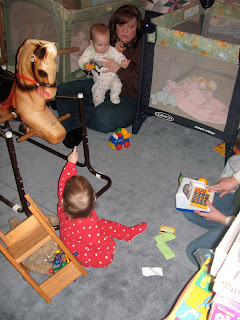
 We also had fun playing together in the toy room (formerly known as “Ryan’s room”).

 I was even able to pick something up for Marc & Frances that they wanted. And this was all at about 11:00 am with NO crowds!
